Imagine you sprain your ankle.
Your first instinct is probably to protect it. You keep weight off it, avoid movements that hurt, and give it time. Early on, that protection may be exactly what your body needs.
But at some point, recovery starts to involve movement again. The ankle has to bend, the muscles around it have to work, and the joint has to carry your weight. Eventually, it has to handle everything an ordinary day asks of it.
If rest gives injured tissue a chance to heal, why does movement become part of recovery at all?
Part of the answer is that tissues don’t only respond to nutrients, hormones, oxygen, blood flow, and immune signals. They also respond to physical force. Movement supports healing. Stretch, tension, compression, and weight all send signals your cells can detect and act on.
Movement is information.
Your Tissues Can Sense Force
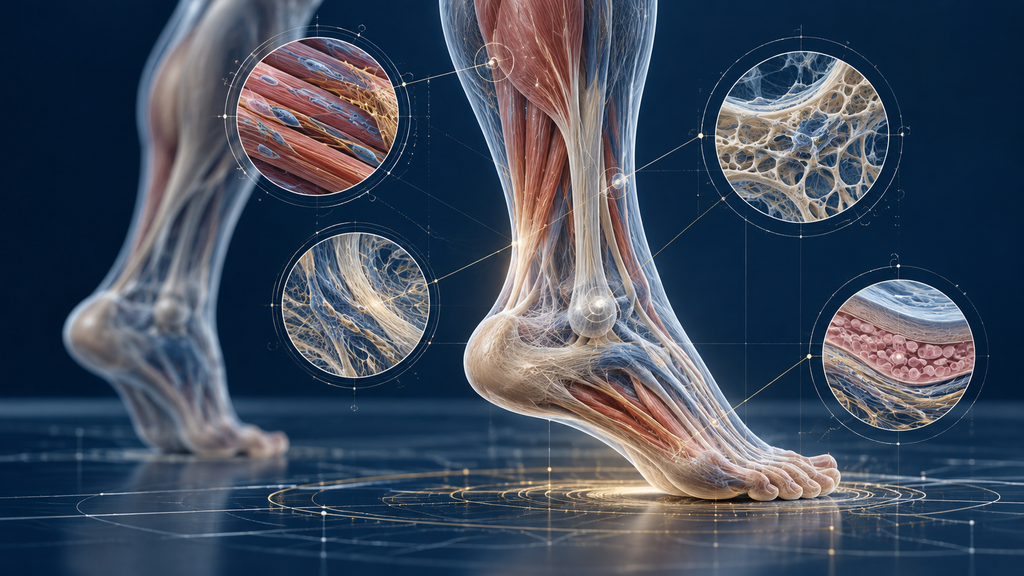
Every time you walk across a room, climb stairs, or lift a grocery bag, forces travel through your body. Muscles contract and pull on tendons, tendons pass that pull to bone, bones bear weight, and connective tissue stretches and recoils.
The cells in these tissues can sense changes in tension, pressure, and fluid movement around them. They translate those physical changes into biological signals that influence how the tissue maintains itself and adapts over time.
Scientists call this process mechanotransduction: the way a physical force becomes a biological message.
Your body is continually taking note of what its tissues are being asked to do.
Bone Responds to the Loads It Carries
Bone can feel solid and permanent, but it’s living tissue that’s constantly being remodeled. Old or damaged bone is cleared away, new bone is laid down, and mechanical load is one of the influences on that process.
Bone cells can detect forces on the skeleton and help guide where bone is maintained and rebuilt. When those forces drop dramatically for a long time, as they can with prolonged bed rest or immobilization, bone loss can follow.
Muscle and Tendon Respond, Too
Most of us have seen this principle in muscle. Challenge a muscle regularly, give it enough resources and recovery, and it adapts. Take the demand away for long enough, and strength and size can decline.
If you’ve ever had an arm or leg in a cast, you may have noticed how quickly that can happen.
Tendons are less obvious but just as responsive. A tendon connects muscle to bone and carries force between them. It’s easy to picture one as a simple cable, but it’s living tissue.
Tendon cells sit within a collagen-rich framework that gives the tendon its structure and strength. That framework is called the extracellular matrix. Mechanical load influences both the cells and the framework around them, and with repeated loading over time, a tendon’s properties can measurably change.
Bone, muscle, and tendon each show the same pattern: the body adapts, in part, to what we ask of it.
Protection and Loading Both Have a Place
So should an injured area rest, or should it move?
It depends. The tissue involved, how badly it’s injured, how far healing has progressed, the treatment, and your overall health can all change what’s appropriate.
Early after some injuries or procedures, protecting the area from too much force may be essential. New tissue is still forming and may not yet tolerate the loads the area handled before.
As we explored in The Healing Response, healing later moves into a remodeling phase, when new tissue becomes more organized and gradually gains strength. This is where mechanical input starts to play a larger role.
Capacity Changes as You Heal
A helpful way to think about this is capacity: how much a tissue can handle right now.
An injury can lower that capacity well below where it was. As healing progresses, it can rise again.
If the demands on a healing tissue keep exceeding what it can currently tolerate, symptoms may flare and the tissue may face forces it isn’t ready for. That’s one reason pushing through isn’t a reliable recovery strategy.
Too little load for too long carries its own costs. Muscle weakens, bone density can decline, tendons may lose some of their tolerance for load, and joints can stiffen.
In rehabilitation, loading is often progressed as the tissue’s capacity grows.
So instead of asking whether to rest or move, it’s more useful to ask what this tissue needs at this stage of healing.
One Injury Can Change How You Move
An injury rarely affects only the injured spot.
A painful knee can change the way you walk. A sore shoulder can change how you use your arm. Less activity overall can affect strength and conditioning elsewhere.
Your nervous system tracks position, balance, and force, and it may find new ways of moving that work around the injured area.
Some of those changes are useful. Guarding a painful area for a while makes sense. But if the original problem improves and the new pattern sticks around, getting function back may take more than waiting for the tissue to finish repairing.
Your whole body adapted to the injury, so recovery may mean helping your whole body adapt again.
Healed Isn’t the Same as Recovered
Repairing tissue and restoring capacity are related, but they aren’t the same thing.
Picture a ligament that’s made it through the early stages of healing. The acute injury is settling down. Everyday life, though, doesn’t care whether new collagen has formed. It asks whether you can walk on uneven ground, climb stairs, carry groceries, get back to work or exercise, and play with your kids.
A tissue can make real progress in repair and still not be ready for demands that felt routine before. Weeks of pain, protection, altered movement, or reduced activity can change strength, mobility, coordination, and tolerance for load.
That’s why feeling better and being fully recovered don’t always arrive together.
Movement Supports Healing But The Right Amount Is Individual
No single amount or type of movement is right for every healing tissue.
A fracture is different from a muscle strain. A surgically repaired tendon is different from a stiff joint. A recent injury is different from pain that has lingered for years.
Age, overall health, activity history, tissue quality, pain, circulation, nutrition, medications, and the nature of the injury all shape recovery. Sometimes a tissue needs protection. Sometimes gradually progressed loading is the right call. Sometimes another issue needs attention before movement can safely increase.
This is why the biology of movement shouldn’t be boiled down to “just move more.” Mechanical input matters, but context decides what it should look like.
Movement Is Part of the Healing Environment
In Building Blocks for Healing, we looked at the nutrients, oxygen, and energy tissues need to repair. Movement works alongside those resources. A tendon needs raw materials to rebuild its framework, and its cells are also responding to the forces placed on it. Bone and muscle do the same, drawing on nutrients and energy while adapting to load.
Healing depends on having enough of those resources, and it’s also shaped by the physical demands a tissue meets as it recovers. Much of recovery comes down to matching those demands to what the tissue is ready for.
The goal isn’t only repaired tissue. It’s a body that can get back to living, moving, and meeting the demands of your life.
Related Articles
Looking Deeper
When recovery stalls, it’s easy to focus only on the spot that was hurt. But a tissue heals inside a whole body. The nutrients available, the energy available for repair, the way you’ve been moving, and the loads of daily life can all influence how that tissue recovers.
A slow recovery doesn’t always point to the injured tissue alone. It may mean one of those other pieces deserves a closer look.
Over time, the question shifts from “Has this tissue healed?” to “What is this tissue ready to do, and what’s shaping its progress?”
Continue Your Discovery
When something hurts, it’s natural to want a simple instruction: rest it or move it?
That question is usually too broad to guide the next step. What tissue is involved, and what happened to it? How far along is healing? What can it handle right now? Has your body changed how it moves to protect the area? Is anything else slowing things down?
Discovery Before Direction means understanding those variables before deciding that more rest, or more movement, is the answer.
If your recovery hasn’t gone the way you expected, Total360 Discovery can help explore the factors that may be influencing your body’s ability to recover.
FAQ
I recommend five questions, especially because these map well to questions a reader could actually search.
Why does movement matter during healing?
Movement creates mechanical forces that cells in bone, muscle, tendons, and other tissues can detect. Through a process called mechanotransduction, those forces are converted into biological signals that can influence tissue maintenance, remodeling, and adaptation.
What is mechanotransduction?
Mechanotransduction is the process by which cells sense physical forces—such as tension, compression, pressure, or load—and convert them into biological signals. It is one way tissues respond and adapt to their mechanical environment.
Should you rest or move an injury?
It depends on the injury, tissue involved, stage of healing, treatment, and individual circumstances. Some injuries require protection, particularly early in healing, while movement or progressive loading may become appropriate later. The goal is to match mechanical demand to what the tissue is ready to tolerate.
Can too much rest slow recovery?
Prolonged unloading can affect muscle strength, bone density, joint mobility, and the ability of tissues to tolerate load. However, this doesn’t mean rest is harmful. Protection can be important during healing; the appropriate balance between protection and loading depends on the injury and stage of recovery.
Why can an injury feel better before you’re fully recovered?
Pain and tissue repair are only part of recovery. During an injury, strength, mobility, coordination, movement patterns, and tolerance for load can also change. A tissue may therefore make substantial progress in healing before the body has fully rebuilt its previous capacity.