
Have you ever noticed your heart racing before a hard conversation, or felt your stomach tighten right before something stressful? Maybe it shows up as tense muscles after a long day, trouble winding down after a demanding week, or a sudden burst of energy when something catches you off guard.
It’s easy to write these off as “just stress.” But something much deeper is happening.
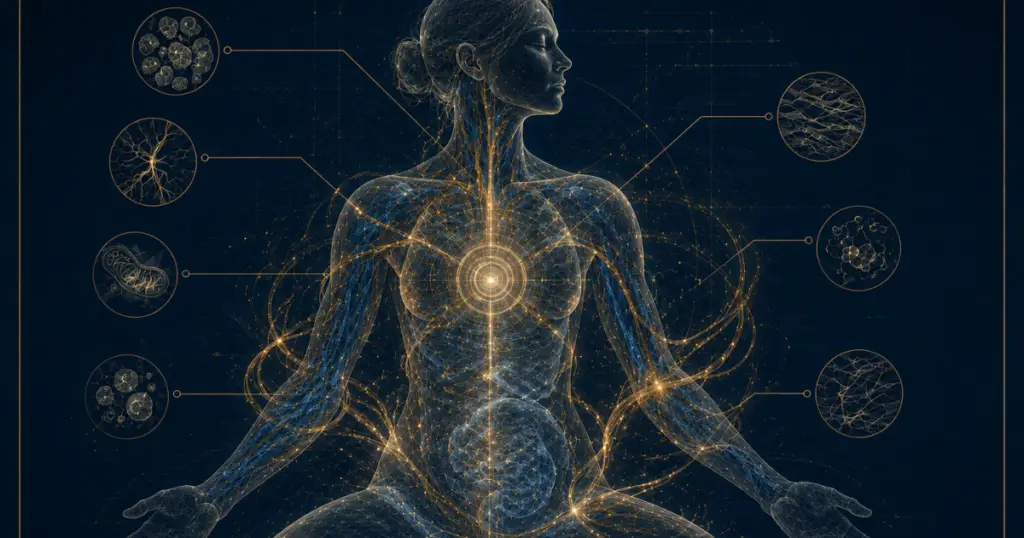
Stress isn’t only an emotion. It’s a biological response—one that involves your nervous system, your hormones, and many of the systems that help your body adapt to what’s happening around you. Your body doesn’t separate emotional experiences from physical demands; it responds to both. Once you understand that, it changes the way you think about stress altogether.
Stress Is a Built-In Survival Response
Stress has a purpose. It’s one of the ways your body recognizes a challenge and prepares you to meet it.
When your brain detects something that needs attention—a physical demand, an emotional challenge, an unexpected change—it starts coordinating a response, and your nervous system carries that message to the rest of your body. This is also why stress feels so physical: your brain and body aren’t running separate jobs. They’re constantly talking to each other, which is why an emotional trigger can produce a very real physical reaction, and why a physical demand can affect how you feel.
This isn’t your body failing you. It’s your body adapting—one of the many ways it’s designed to protect you.
What Actually Changes When You’re Stressed
Because the response involves your brain, nerves, hormones, and circulation working together, its effects reach well beyond your emotions:
- Heart and breathing – a racing heart before speaking in front of others, or breathing that shifts to help deliver oxygen and support quick action.
- Muscles – tense shoulders or a tight jaw as your body primes for movement.
- Digestion – a nervous stomach before something important, since your body prioritizes resources during a challenge.
- Attention – a sharper, more alert focus on whatever feels most important right now.
- Energy – hormones like adrenaline make fuel available quickly, so you can respond fast.
None of this is random, and none of it is imaginary—every item on that list is part of the same coordinated response.
Stress Isn’t Always the Enemy
It’s tempting to think of stress as something harmful that should be eliminated. But a life without stress isn’t the goal—stress helps you respond, prepare, and adapt. It’s what allows an athlete to perform under pressure or helps you push through a demanding deadline.
The body doesn’t experience every challenge the same way, but many different demands—an injury, an illness, a lack of sleep, or an emotionally difficult season—can involve overlapping biological responses. So the real question isn’t whether stress exists. It’s whether your body has the capacity to respond appropriately to what it encounters.
Understanding Stress Changes the Conversation
When people notice stress-related symptoms, they often ask, “Why am I feeling this way?” That’s a fair question. But there’s another one worth asking too: “What is my body responding to?”
Stress is one piece of a much larger picture of health—it doesn’t explain every symptom. Fatigue, digestive changes, sleep problems, and pain can all have many possible contributors. But understanding how stress affects your biology helps you see that mind and body were never really separate to begin with.
Supporting a Healthy Stress Response
The goal isn’t to avoid every challenge—challenges are part of life. The goal is to support your body’s ability to respond, adapt, and return to balance. Foundational habits like consistent sleep, adequate nutrition, regular movement, meaningful connection, and time to rest all support the systems involved in that process.
Understanding your body’s responses is the first step. Because once you understand them better, you can make better decisions about how to support your health.
Related Articles
- How Chronic Stress Changes the Body
- Why the Nervous System Gets Stuck in Survival Mode
- Stress, Hormones, Digestion, and Inflammation
- Building Resilience From the Foundation Up
Looking Deeper
Stress isn’t simply a feeling—it’s a conversation happening throughout the body. Your nervous system, hormones, immune system, circulation, digestion, and energy systems are constantly communicating to help you adapt to what life requires.
When we understand stress as biology, not just emotion, we can start looking at symptoms with more curiosity. Instead of asking only “How do I stop feeling stressed?” we can start asking, “What is my body trying to communicate?”
Continue Your Discovery
Your body is designed to adapt. But understanding what it’s adapting to is an important part of understanding your health.
That is the foundation of a different approach to healthcare: understanding how your body was designed to function before looking at what may be interfering with it.
The Total360 Discovery looks at the chemical, mechanical, and energy aspects of health to help identify patterns and potential contributors that may be influencing how your body functions.
Discovery Before Direction.
Learn more about the Total360 Discovery →
FAQ
Is stress only an emotional experience? No. Stress is both an emotional experience and a biological response. When your body detects a challenge, your nervous system, hormones, and other systems work together to help you adapt.
Why does stress cause physical symptoms? Because the stress response itself involves changes throughout the body. Heart rate, breathing, muscle activity, energy availability, and attention can all shift as part of that response.
Does stress affect everyone the same way? No. People respond differently to the same type of stress. Genetics, past experiences, environment, health status, and available resources can all shape how the body responds.
Is stress always harmful? No. Stress is a normal part of being human, and it can be helpful. Short-term stress can improve focus, energy, and adaptation. Problems tend to arise when demands exceed the body’s ability to respond and recover.