You open your mammogram report and see the words dense breast tissue.
For many women, that’s the first time they’ve ever thought about breast density. And without much context, the word dense can sound like something abnormal was found.
But breast density isn’t a diagnosis. It’s a description of how your breast tissue looks on a mammogram.
It’s also very common. About half of women 40 and older have dense breasts. And because mammogram reports in the U.S. are now required to include breast density, more women are seeing this language than ever before.
So what exactly is dense breast tissue and why do some women have more of it than others?
What Does “Dense Breast Tissue” Actually Mean?
Breasts are made of a mix of tissues. Glandular tissue includes the lobules that produce milk and the ducts that carry it. Fibrous connective tissue forms the supportive framework that holds everything in place. Fat fills in the space around them.
The balance of these tissues varies from woman to woman.
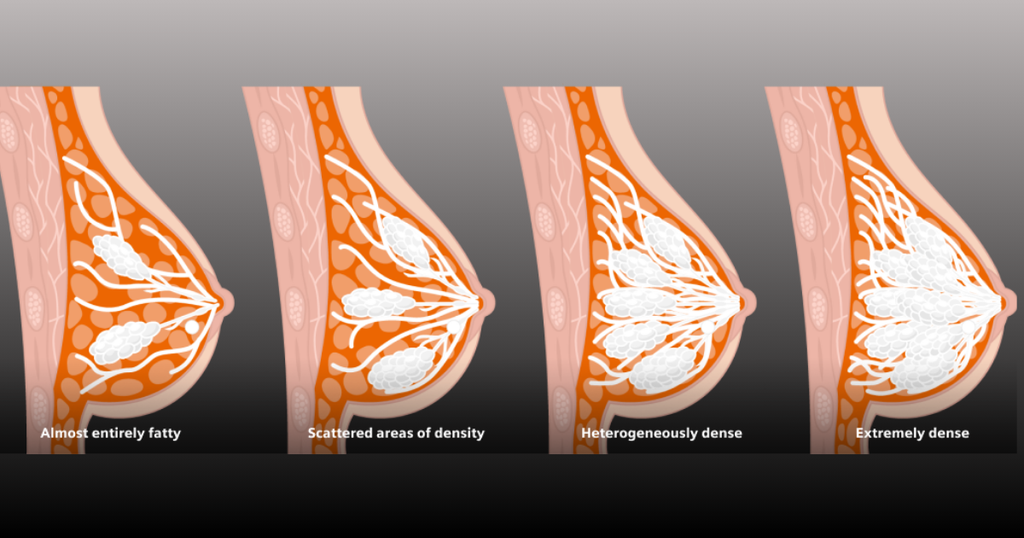
On a mammogram, fat appears dark, while glandular and fibrous tissue appear white. Together, glandular and fibrous tissue are often called fibroglandular tissue. When a breast contains more of it relative to fat, it’s described as dense.
Radiologists place breast density into one of four categories:
- Almost entirely fatty
- Scattered areas of fibroglandular density
- Heterogeneously dense
- Extremely dense
The last two categories are considered dense breasts.
Here’s an important distinction: breast density isn’t something you can reliably determine by touch.
A breast that feels firm isn’t necessarily dense on a mammogram, and a breast that feels soft can still contain dense tissue. Density describes the internal makeup of the breast as it appears on imaging.
Why Are Some Breasts Denser Than Others?
There isn’t one single cause of dense breast tissue.
Much of it is simply natural variation. Genetics plays a role, and breast density often runs in families.
Age matters, too. Younger women are more likely to have dense breasts, and density often decreases over time, particularly after menopause.
Hormones have an influence as well. Breast tissue is highly responsive to hormones, and some hormone therapies, particularly combined estrogen and progestin therapy, can increase mammographic density.
Reproductive history and body composition are also associated with differences in breast density.
Breast density reflects tissue composition, and that composition is shaped by many parts of a woman’s biology.
Breast Tissue Changes Over Time
Your breast density today isn’t necessarily the density you’ll have for the rest of your life.
Breast tissue remodels. Pregnancy, breastfeeding, weaning, menopause, and shifting hormones can all change its structure and composition.
For many women, the proportion of fibroglandular tissue declines with age while fatty tissue increases, so density decreases. But not every woman follows the same pattern. Some continue to have dense breasts well after menopause.
Medications can play a role, too. While some hormone therapies may increase density, certain medications used to lower breast cancer risk can reduce it in some women.
There isn’t one breast composition that every woman is supposed to have.
Why Does Breast Density Matter?
Breast density matters for two separate reasons.
The first involves what a mammogram can see.
Dense tissue appears white on a mammogram. Many breast abnormalities also appear white. That can make an abnormality harder to distinguish from the tissue around it.
Radiologists often compare it to trying to spot a snowball in a snowstorm. The snowball hasn’t changed. The contrast around it has.
The second reason is different: higher breast density is also associated with an increased risk of developing breast cancer.
Researchers are still studying why. One possible contributor is that dense breasts contain more of the glandular tissue where most breast cancers begin. But tissue composition is only one part of a woman’s overall risk.
Having dense breasts does not mean you have breast cancer or that you will develop it.
It means density is one more piece of information to consider alongside the rest of your health and risk profile.
If I Have Dense Breasts, Do I Need More Testing?
Not necessarily.
Breast density is one piece of the screening picture. Your age, family history, personal medical history, genetic risk, and previous breast findings all contribute to your overall breast cancer risk.
For some women with dense breasts, additional imaging may be appropriate. Depending on density and individual risk, your healthcare provider may discuss options such as breast ultrasound or MRI in addition to mammography.
So the more useful question isn’t simply, “Do I have dense breasts?”
It’s, “What does my breast density mean in the context of my overall breast health and risk?”
That’s a much better conversation to have with your healthcare provider.
Dense Breasts Aren’t the Same as Lumpy Breasts
Another common source of confusion is the difference between dense breasts and fibrocystic breasts.
Breast density is an imaging description. It reflects the proportion of fibroglandular tissue and fat seen on a mammogram.
Fibrocystic changes involve changes within breast tissue that may cause lumpiness, tenderness, cysts, or areas that feel different to the touch.
A woman can have dense breasts without fibrocystic changes, fibrocystic changes without dense breasts, or both.
Knowing the difference can make breast reports and conversations about them much less confusing.
Understanding Changes the Conversation
Being told you have dense breasts is information about your breast tissue. Not a verdict.
Knowing your breast density can help you and your healthcare provider think more clearly about screening, your personal risk, and whether anything beyond routine mammography makes sense for you.
The more you understand about your own breast tissue, the better equipped you are to take part in decisions about caring for it.
Related Articles
Looking Deeper
Most women first learn about breast density from a mammogram. That can make density feel like something the mammogram discovered or something that suddenly appeared.
But the mammogram didn’t create the density. It gave us a way to see a characteristic of the tissue that was already there.
Breast density is one example of why breast health involves more than asking whether disease was found. Imaging can also tell us something about the tissue itself, what it’s made of, how easily it can be evaluated, and what that may mean for future screening decisions.
Understanding those details gives you more context for caring for your breast health over time.
Continue Your Discovery
A mammogram can tell you whether your breasts are dense. But breast density is only one part of understanding your breast tissue.
Denali’s Best Breast Health approach looks more broadly at breast tissue and the biological environment surrounding it, helping women better understand their individual breast health and take a more active role in caring for it throughout life.
Discovery Before Direction.