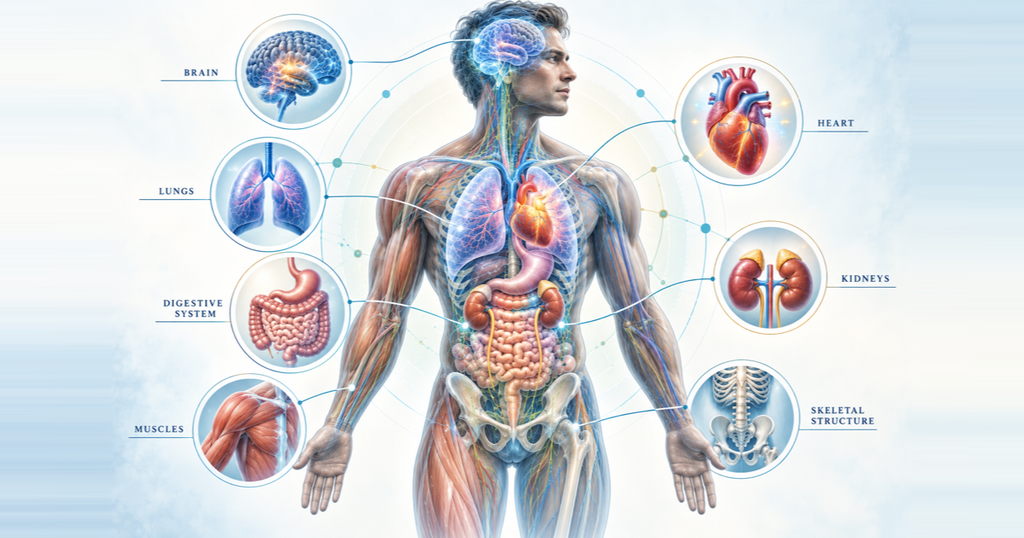

Think about what sleep looks like from the outside.
You lie down.
Your eyes close.
Your muscles relax.
For several hours, you’re not working, eating, exercising, or consciously responding to everything happening around you.
It can look like the body has simply shut down for the night.
But sleep is not the absence of activity.
Inside the body, something very different is happening.
The brain moves through organized stages of sleep. Hormone patterns change. Immune activity shifts. Metabolism changes. The nervous system adjusts. The body continues maintaining tissues, regulating inflammation, managing energy, and carrying out processes involved in recovery, including sleep and cellular repair.
The Role of Sleep and Cellular Repair
You may look inactive.
Your biology is not.
Sleep does not stop the body’s work.
It changes the kind of work the body is able to prioritize.
Sleep Is an Active Biological State
Sleep has structure. Throughout the night, the brain cycles through different stages of non-REM and REM sleep, repeating in an organized pattern as the body’s physiology changes along with them.
Heart rate, breathing, nervous-system activity, hormone release, and brain activity all shift as we move through the night — each stage carrying its own rhythms and priorities.
Healing Doesn’t Stop During the Day—and It Doesn’t Begin at Night
Because we’re talking about sleep and repair, it would be easy to say:
“Your body heals while you sleep.”
But that is only part of the story.
Your body is healing around the clock. Cells are repairing damage while you are awake. The immune system is active throughout the day. Tissue remodeling doesn’t suddenly begin when your head hits the pillow.
What changes during sleep is the biological environment in which that work is happening. Movement, sensory input, nervous-system activity, and hormonal and metabolic signals all shift.
Sleep gives the body a different set of conditions in which to perform some of the work involved in maintenance, regulation, and recovery.
So sleep doesn’t turn healing on.
It helps create an environment that supports it.
Deep Sleep Changes the Hormonal Environment
One clear example is growth hormone, which supports growth, metabolism, tissue maintenance, and repair.
In adults, one of the most consistent pulses of growth-hormone release occurs shortly after sleep begins, closely associated with the first period of deep, slow-wave sleep.
That doesn’t mean growth hormone alone explains healing—it’s one example of a larger pattern. Hormone levels shift across the sleep-wake cycle, creating a different chemical environment than the one we experience while awake, and that environment matters for restoration.
The Immune System Doesn’t Go to Sleep When You Do
Sleep and the immune system have a remarkably close relationship.
The immune system influences sleep, and sleep influences immune activity.
During normal sleep, patterns of immune-cell movement and immune signaling change. Different immune functions follow their own rhythms across sleep and wakefulness.
That connection matters for healing because the immune system is deeply involved in tissue repair.
As we explored in The Healing Response, immune activity helps identify damage, coordinate inflammation, clear damaged material, and create conditions for rebuilding.
Sleep is therefore connected to healing not because the immune system suddenly switches on at night, but because sleep is part of the regulatory environment in which immune function operates.
Sleep and Inflammation Are Connected
Because the immune system participates in healing, changes in immune regulation also affect the inflammatory environment where repair takes place.
Inflammation is a normal, necessary part of responding to injury—but it has to be regulated. Human research has repeatedly connected disrupted sleep with changes in inflammatory activity, and repeated partial sleep loss appears more consistently linked to those changes than a single poor night.
That distinction matters. One rough night doesn’t mean your body loses its ability to recover—the body is remarkably adaptable. The bigger concern is when shortened, fragmented, or poor-quality sleep becomes the pattern rather than the exception.
Sleep Affects the Way the Body Handles Energy
Healing requires energy, and sleep plays a role in how the body manages it—influencing glucose regulation, insulin sensitivity, appetite-related hormones, and other aspects of metabolism.
Poor sleep on its own isn’t a cause of metabolic disease—but it does shape the metabolic environment that determines how the body manages its resources.
Repair isn’t free—cells need energy to communicate, produce proteins, divide, and rebuild tissue, and sleep helps regulate that energy economy.
Physical Recovery Is More Than Feeling Rested
Anyone who has exercised hard, recovered from surgery, or been sick knows the body feels different after poor sleep—and physical recovery is more than just feeling rested.
Human studies have found that sleep restriction has been shown to affect muscle protein synthesis and delay skin-barrier recovery in experimental settings, and poorer sleep during surgical recovery has been linked with worse wound-healing outcomes.
Sleep clearly isn’t the only factor at play here—but the evidence shows it’s one of the conditions the body relies on as it repairs.
Your Brain Has Restoration Work of Its Own
Your muscles, skin, and connective tissues aren’t the only parts of the body that need maintenance—the brain does too.
One growing area of research involves the movement of cerebrospinal fluid and the clearing of metabolic waste from brain tissue, often discussed as the glymphatic system.
Animal evidence strongly supports a link between sleep and glymphatic activity, though researchers are still working out exactly how it operates in humans—which is why we should be cautious about the popular claim that the brain simply “detoxes while you sleep.” The emerging biology is more interesting than that: sleep appears to change fluid dynamics and clearance within the brain, another example of how differently the body functions while asleep.
Resting Isn’t the Same as Sleeping
This helps explain why lying on the couch for eight hours isn’t biologically equivalent to sleeping for eight hours.
Rest can reduce physical demand and be valuable, but sleep involves physiological changes—shifting brain stages, hormones, immune and metabolic activity, and brain-fluid dynamics—that simple inactivity doesn’t reproduce.
Sleep isn’t just “doing less”; it’s a different biological state, which is why the body needs both rest and sleep. They’re related, but not interchangeable.
What Happens When Sleep Is Repeatedly Interrupted?
One poor night is usually something the body can accommodate—a new baby, jet lag, pain, stress. Life happens, and the body is built to adapt to variation.
The concern is when disrupted sleep becomes chronic.
Night after night, the body loses part of the biological environment that normally accompanies consolidated sleep, and over time this can influence immune regulation, inflammation, glucose metabolism, hormone patterns, pain sensitivity, cognition, and recovery.
Healing hasn’t stopped, and the body hasn’t forgotten what to do—but one of the conditions that normally supports restoration keeps being interrupted. That distinction matters.
The Nervous System Is Part of the Sleep Story
Falling asleep isn’t purely an act of will—the brain and nervous system participate in that transition, and when the body remains highly activated, falling or staying asleep can become more difficult.
But that doesn’t mean every sleep problem is a nervous-system problem: sleep disorders, breathing disturbances, medications, hormones, pain, illness, and environmental factors can all interfere with sleep.
Like healing itself, sleep is connected to multiple systems working together.
Sleep Is Part of the Healing Environment
When we step back, an important pattern emerges.
Healing requires more than the damaged tissue itself. It depends on immune coordination. Hormonal signaling. Energy availability. Metabolism. Nervous-system regulation. Time. And sleep.
Sleep doesn’t create healing. It doesn’t guarantee recovery. And it isn’t the only time repair occurs.
But it provides a distinct biological environment that supports many of the processes involved in restoration.
That’s why sleep should not be thought of as time lost from the day.
It is part of the body’s work.
You may be unconscious. But your body is still maintaining, regulating, rebuilding, and preparing for what comes next.
Sometimes the most productive thing the body does is work we never see.
And some of that work happens while we sleep.
Related Articles
Looking Deeper
Sleep is often treated as a lifestyle habit—something we should simply be more disciplined about.
But sleep is also biology.
Pain, stress, breathing disturbances, hormones, medications, illness, environmental factors, and nervous-system activity can all influence the ability to fall asleep, stay asleep, and move through normal sleep cycles.
That means disrupted sleep is not always just a matter of needing better habits.
Sometimes it is another clue about what the body is managing.
And because sleep influences so many systems involved in recovery, understanding why sleep is disrupted may be just as important as recognizing that sleep matters.
Discovery Before Direction
It is easy to look at poor sleep and immediately ask:
“What can I take to help me sleep?”
Sometimes a treatment or short-term intervention is appropriate.
But another question may need to come first:
“Why is restorative sleep being interrupted?”
Is pain waking the body? Is breathing disrupted? Are hormonal changes involved? Is the nervous system remaining highly activated? Is another health issue interfering with normal sleep?
Discovery Before Direction means understanding the pattern before assuming the solution.
Because sleep is not simply something we make ourselves do.
It is a biological process—and when that process is repeatedly disrupted, understanding why can help us make better decisions about what comes next.
FAQ
Does your body actually repair itself while you sleep?
Yes, but healing does not happen only during sleep. Repair occurs around the clock. Sleep creates a distinct biological environment in which hormone signaling, immune activity, metabolism, nervous-system activity, and other processes involved in maintenance and recovery change.
Why is deep sleep important for recovery?
Deep, slow-wave sleep is associated with physiological changes involved in restoration, including a prominent pulse of growth hormone in adults. Growth hormone participates in metabolism, tissue maintenance, and repair, although healing depends on many processes beyond any single hormone.
Does poor sleep increase inflammation?
Repeated insufficient or disrupted sleep has been associated with changes in inflammatory signaling. One occasional poor night is different from a persistent pattern of inadequate or fragmented sleep, and inflammation is influenced by many factors beyond sleep alone.
Does the brain clear waste while you sleep?
Research suggests sleep influences cerebrospinal-fluid movement and systems involved in clearing metabolic waste from brain tissue. Evidence is especially strong in animal research, while scientists continue studying exactly how glymphatic processes operate in humans. It is more accurate to describe this as an area of ongoing research than to say the brain simply “detoxes” during sleep.
Is resting the same as sleeping for recovery?
No. Rest can reduce physical and mental demands, but sleep produces physiological changes that ordinary inactivity does not. The brain cycles through distinct sleep stages while hormone signaling, immune activity, metabolism, nervous-system activity, and other processes change.