When you scrape your knee, strain a muscle, or cut your finger, it can seem like something has simply gone wrong.
Something was injured.
Something was damaged.
Something needs to be repaired.
But underneath the surface, something remarkable is already happening.
The moment tissue is injured, your body begins a carefully coordinated response designed to protect you, clear away damage, rebuild what was lost, and gradually restore function.
You don’t have to think about it.
You don’t have to tell your immune system what to do.
You don’t have to direct your cells where to go.
Your body already has built-in biological processes designed to respond.
This process is called the healing response.
And it is one of the most remarkable examples of the body’s ability to adapt, repair, and restore itself.
That doesn’t mean every injury heals perfectly or every tissue can fully restore itself. Biology has limits. Some injuries are more complex than others. Some tissues have greater healing capacity than others.
But the process itself is remarkably organized.
Healing Begins With a Signal
The body is constantly monitoring what is happening inside and around it.
Cells communicate with one another. The immune system watches for threats. Blood vessels respond to changing demands. Tissues adjust to the forces placed upon them.
When an injury occurs, the body receives a signal:
Something has changed. Something needs attention.
That signal begins a coordinated cascade of events. Damaged cells release chemical messages, blood vessels respond, and immune cells move toward the area — and together, these signals mark the beginning of an organized response.
The goal is not simply to cover up the damage.
The goal is to restore enough structure and function that the tissue can do its job again.
Healing is not random.
It is a coordinated process.
The First Phase: Protection and Inflammation
The first priority after injury is protection.
Before rebuilding can happen, the body has to understand what happened and prevent further problems.
This is where inflammation enters the story.
Inflammation often gets described as something harmful. We hear about “reducing inflammation” so often that it is easy to assume inflammation itself is the problem.
But inflammation is actually one of the body’s most important healing tools.
When tissue is injured, inflammation helps:
- signal that damage has occurred
- increase blood flow to the area
- bring immune cells to the site
- remove damaged or unwanted material
- prepare the tissue for repair
Think about what happens after a storm.
Before rebuilding a damaged building, someone has to assess what happened, remove debris, and create a safe environment for reconstruction.
Inflammation serves a similar purpose.
It is the body’s preparation phase.
The goal is not to eliminate inflammation completely.
The goal is for inflammation to do its job and then resolve.
The Second Phase: Rebuilding Begins
Once the body has assessed the damage and cleared away what needs to be removed, the rebuilding process begins.
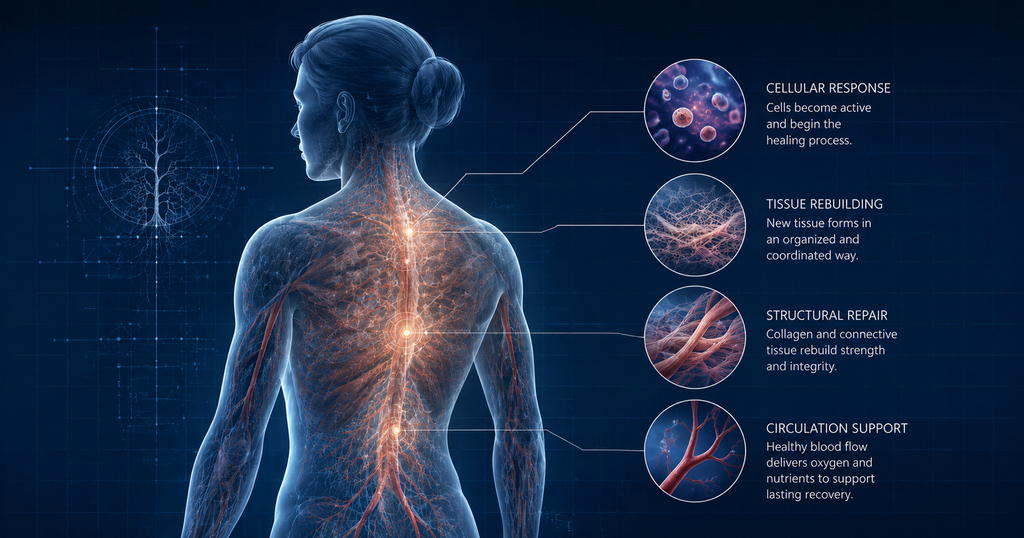
New cells are created, structural proteins are produced, and blood vessels may grow into areas that need additional support — together, these processes create new tissue and begin restoring the structures that were damaged.
This phase requires enormous coordination. Cells need instructions, energy, oxygen, and nutrients. They also need communication signals telling them what to build and where to build it.
The body is not simply filling in a gap.
It is rebuilding a living structure.
A healed bone is not simply a break that has been glued back together. It is living tissue that has been reorganized to handle the forces placed upon it.
A repaired tendon is not simply closed. Over time, it adapts to tolerate movement and the demands placed on it.
Healing is not just about repairing what was lost.
It is about restoring function.
The Third Phase: Remodeling and Adaptation
Healing does not end when new tissue forms.
The final phase is remodeling.
During remodeling, the body continues adjusting and organizing the repaired tissue.
New collagen fibers become stronger and better organized. Bone continues to adapt to the forces placed upon it, while muscle and connective tissue gradually adjust to the demands of movement.
Remodeling is where the body fine-tunes the repair. It strengthens what needs strengthening, reorganizes tissue, and adapts the repaired area to the demands it will face in the future.
The body is not just repairing what was damaged.
It is learning from what happened.
This is why rehabilitation and gradual return to activity are often such important parts of recovery.
These phases are not separate events that happen one after another.
Inflammation does not simply end before rebuilding begins. Remodeling does not wait until every other process is finished.
Instead, these stages overlap and communicate with one another throughout the healing process.
Healing Is Not the Same for Every Tissue
One of the most interesting parts of healing is that different tissues repair at different speeds and in different ways.
A small cut on the skin may heal relatively quickly.
A broken bone may require months of rebuilding and remodeling.
A tendon or ligament injury may take longer because those tissues have different blood supplies and structural demands.
Cartilage can be especially challenging because it has a limited ability to repair itself compared with other tissues.
The body is always trying to restore what was damaged.
But the blueprint, resources, and timeline depend on what kind of tissue is involved.
Why Healing Can Take Time
Because healing is a complex process, it requires more than simply waiting.
The body needs the right environment to complete the work.
Healing depends on:
- adequate blood flow to deliver oxygen and nutrients
- immune activity that is coordinated and appropriate
- enough energy to support repair
- raw materials to build new tissue
- mechanical signals that guide adaptation
- time for remodeling to occur
This is why recovery isn’t simply about how quickly symptoms disappear — a tissue may feel better before it has fully remodeled, or may still be rebuilding even after the original injury is no longer obvious.
Healing happens beneath the surface long before we can see the final result..
When Healing Becomes Disrupted
Sometimes the healing response works exactly as intended.
The injury occurs. The body responds. The tissue rebuilds. Function returns.
But sometimes healing becomes disrupted.
The injury may be more severe than the body can easily repair, or the tissue may not be receiving enough blood flow or resources. Ongoing stressors can interfere with recovery, inflammation may not resolve appropriately, or movement patterns may continue placing stress on healing tissue.
When healing slows, it’s rarely because the body has forgotten what to do. More often, something else is influencing the process — because the body is rarely doing just one thing at a time.
Healing Is a Whole-Body Process
It can be tempting to think of healing as something that happens only at the location of injury.
A knee heals. A shoulder heals. A cut heals.
But the healing response involves the entire body — and depends on several systems working together:
- The immune system coordinates protection and repair.
- The circulatory system delivers oxygen and nutrients.
- The nervous system communicates information about the body’s needs.
- Hormones influence metabolism and repair signals.
- Nutrition provides the materials needed for rebuilding.
- Movement helps tissues adapt to future demands.
- Sleep supports the body’s restorative processes.
Healing may happen in one location.
But it depends on the entire system.
Supporting the Body’s Natural Healing Process
The body already knows how to heal — that ability is built into biology, not something it has to be taught.
But healing works best when the body has the conditions it needs:
- enough resources
- appropriate movement
- adequate recovery
- balanced immune activity
- healthy communication between systems
This is why understanding healing means looking beyond the injured area alone — the symptom tells us where the problem is felt, while the healing response tells us what the body is trying to accomplish.
And sometimes, the most important question is not:
“How do we force the body to heal?”
It is:
“What does this body need in order to complete the healing process it already began?”
Understanding that process is the first step toward supporting restoration.
Related Articles
Looking Deeper
Healing is one of the body’s most complex processes because it depends on many systems working together.
The tissue where you feel the problem is often only one part of the story.
The immune system, circulation, nutrition, energy production, hormones, nervous system regulation, movement, and recovery all influence the environment where healing takes place.
When healing slows, it may be worth looking beyond the location of the injury and asking a bigger question:
What conditions are influencing the body’s ability to repair and restore?
Understanding those connections is one reason Foundational Medicine begins with discovery before direction.
Continue Your Discovery
At Denali, Total360 Discovery looks across chemical, mechanical, and energy health to understand the patterns that may be influencing how your body functions, adapts, and recovers.
Because healing depends on more than the location where a problem is felt.
When you understand the bigger picture of what your body is experiencing, you can make more informed decisions about how to support restoration.
Learn more about Total360 Discovery →
FAQ Answers
What is the healing response?
The healing response is the body’s coordinated process of protecting damaged tissue, removing what is no longer needed, rebuilding structures, and remodeling tissue so function can be restored.
What are the stages of healing after an injury?
Healing generally involves three overlapping phases: protection and inflammation, rebuilding and repair, and remodeling. These phases communicate with one another rather than occurring as completely separate steps.
Why does inflammation happen after an injury?
Inflammation is part of the body’s normal response to damage. It helps identify the problem, bring immune cells to the area, remove damaged material, and prepare the tissue for repair.
Why do some injuries take longer to heal?
Healing time depends on many factors, including the type and severity of injury, tissue involved, blood flow, available nutrients, energy, movement, sleep, and other demands placed on the body.
What happens during tissue remodeling?
During remodeling, the body continues organizing and strengthening repaired tissue. It adapts the tissue so it can better handle the demands it will experience in the future.