Most of us rarely think about what’s happening inside our breast tissue from day to day. But beneath the surface, a quiet network is always at work: the lymphatic system.
Lymphatic vessels are found throughout the body, quietly collecting fluid from the spaces around our cells and carrying it through a network of vessels and lymph nodes.
The breasts are part of that network.
And once you understand what the lymphatic system is doing, some of the anatomy of the breast begins to make much more sense.
What Is the Lymphatic System Doing All Day?
To understand lymph, it helps to start with blood.
As blood moves through tiny vessels called capillaries, some of its fluid moves out into the spaces surrounding our cells. This exchange helps deliver oxygen and nutrients to cells and supports the normal work happening throughout the body.
This fluid is called interstitial fluid.
And it needs somewhere to go.
Tiny lymphatic vessels collect excess fluid from the tissues. Once that fluid enters the lymphatic system, we call it lymph.
Lymph can contain water, proteins, immune cells, cellular material, and other substances collected from the tissues. It travels through increasingly larger lymphatic vessels, passes through lymph nodes along the way, and eventually returns to the bloodstream.
This process is happening continuously throughout the body—including in breast tissue.
Your Breasts Have Their Own Lymphatic Network
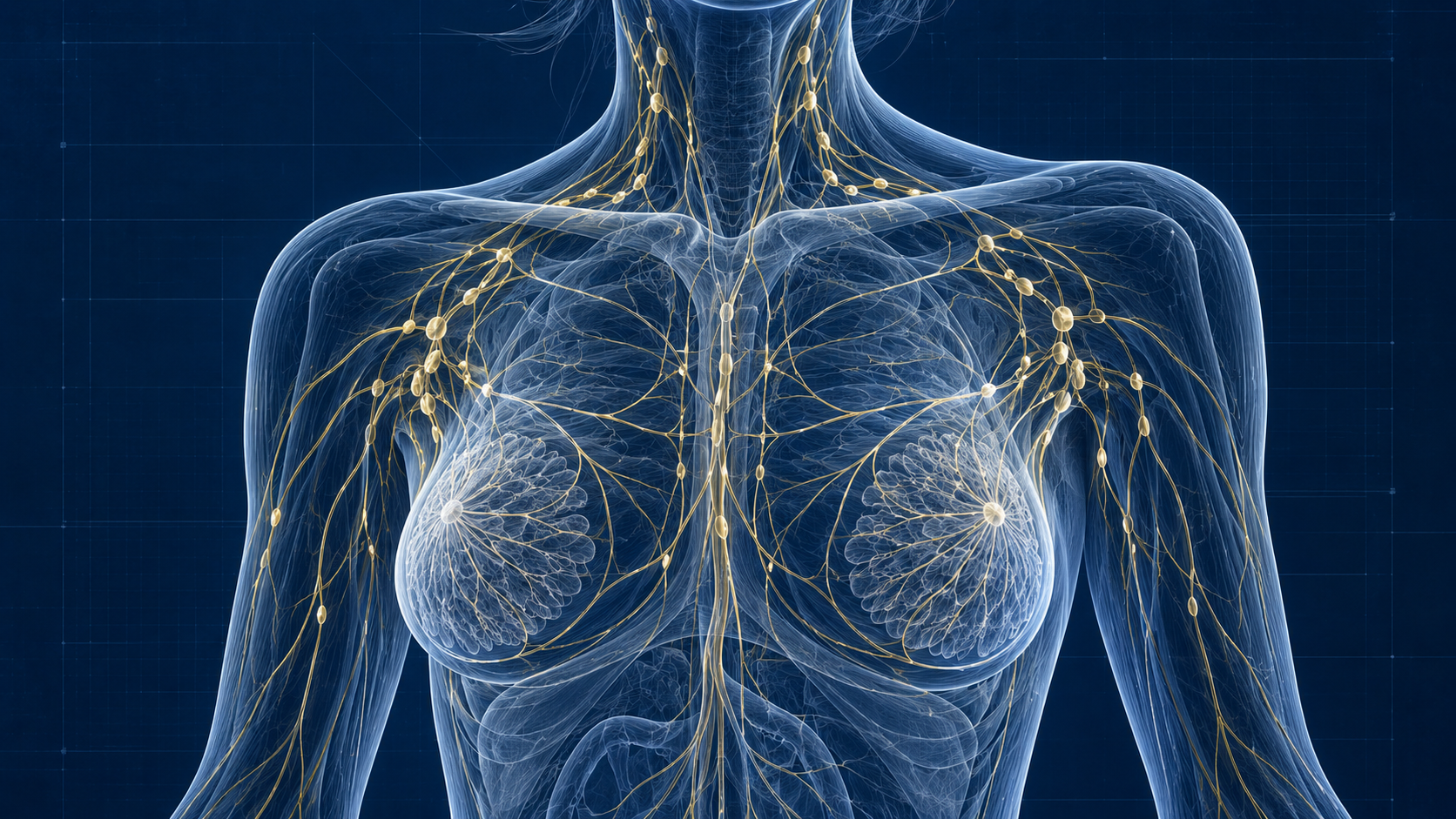
Breast tissue contains an extensive network of lymphatic vessels.
Some lie closer to the surface, while others travel deeper through the tissue. Together, they collect lymph and carry it along specific anatomical pathways toward lymph nodes in surrounding regions.
Much of the lymphatic drainage from the breast ultimately travels toward lymph nodes in the axilla, or underarm. Other pathways can carry lymph toward nodes deeper within the chest, including nodes located near the breastbone.
The exact pattern isn’t identical in every person or every area of the breast.
But there is an anatomical pattern.
Breast lymph travels through an organized, three-dimensional network with particular pathways and destinations.
Understanding that leads to another question:
How does lymph actually move?
How Does Lymph Move Without a Heart to Pump It?
Blood and lymph move through the body differently.
Your circulatory system has a powerful central pump. Every time your heart beats, it creates pressure that helps move blood through your blood vessels.
The lymphatic system doesn’t have an equivalent central pump.
Instead, lymph movement depends on several mechanisms working together.
Larger lymphatic vessels can contract rhythmically to help propel lymph forward. One-way valves inside the vessels help prevent backward flow. Movement of the muscles and tissues surrounding lymphatic vessels creates changes in pressure that can also help move lymph. Even breathing contributes to pressure changes that influence lymphatic flow through the body.
This is one reason movement matters to lymphatic function.
It’s also part of the reason massage enters the conversation.
Gentle external pressure can influence superficial tissues and lymphatic vessels. But moving the skin or massaging an area isn’t automatically the same thing as lymphatic drainage.
For that, anatomy matters.
Lymphatic Drainage Is Not Simply Massage
Lymphatic drainage depends on understanding where lymphatic vessels are located, how they connect, and where fluid is being directed.
This is especially important in breast tissue because its lymphatic network has specific drainage patterns and connections to regional lymph nodes.
Those pathways can also be altered by breast surgery, radiation, lymph-node removal, injury, or conditions affecting the lymphatic system.
So there is a meaningful difference between creating movement in tissue and intentionally directing lymphatic drainage.
The second requires an understanding of the anatomy.
And once lymph leaves the breast, another part of the lymphatic system becomes important: the lymph nodes.
What Happens Inside a Lymph Node?
Lymph nodes are sometimes described as filters, but that description only captures part of what they do.
They are small, organized structures containing many immune cells. As lymph arrives from the tissues, it carries cells and substances from those tissues with it.
Inside the lymph nodes, immune cells encounter some of that material and participate in the body’s ongoing immune surveillance.
Think of them as biological checkpoints along the lymphatic network.
This helps explain why clusters of lymph nodes are positioned in strategic places throughout the body, including the underarms, neck, chest, abdomen, and groin.
For breast tissue, the relationship with the underarm is especially important.
Why Does the Underarm Matter?
A large portion of breast lymphatic drainage travels toward the axillary lymph nodes.
Breast tissue also extends toward the underarm in an area commonly called the axillary tail. This is one reason a clinical breast evaluation may include the underarm rather than stopping at the visible boundaries of the breast.
Not every area of the breast drains through exactly the same route, and the axillary nodes aren’t the only nodes involved.
But the close anatomical relationship between breast tissue, its lymphatic vessels, and the axillary lymph nodes makes the underarm part of the larger breast-health picture.
What Happens When Lymphatic Drainage Is Disrupted?
We can see the importance of this network clearly when its normal pathways are disrupted.
Some people who undergo breast cancer treatment have lymph nodes removed or lymphatic vessels affected by surgery or radiation.
When those pathways are damaged, lymph may have more difficulty leaving the affected tissues. Fluid can accumulate, leading to a condition called lymphedema.
After breast cancer treatment, lymphedema can affect the arm, hand, breast, or chest on the treated side.
Not everyone who undergoes breast cancer treatment develops lymphedema, and the degree of risk depends on many factors.
Lymphedema shows us what can happen when normal lymphatic pathways are disrupted and fluid can no longer move as effectively through the system.
A System That Connects the Breast to the Body
It’s easy to think of the breast as a distinct structure sitting on the chest.
Biologically, its boundaries are much less separate.
Blood vessels bring circulation into the tissue. Lymphatic vessels help manage the fluid around its cells. Lymph nodes connect the tissue with a larger immune network. Hormones influence how breast tissue develops and changes. Connective tissue provides structure and support.
These connections are part of what makes breast tissue living, changing tissue.
The lymphatic system gives us a particularly clear view of that biology. Its vessels may be small and largely invisible, but they’re continuously helping maintain the environment in which breast cells live.
Understanding how those systems work gives us another way to care for breast health throughout life—by beginning with the biology of the tissue itself.
That’s part of stewardship.
Related Articles
Continue Your Discovery
Understanding how the lymphatic system works is one part of understanding breast health more fully.
Denali’s Best Breast Health approach looks beyond screening alone to help women better understand their breast tissue and the systems that influence it—including lymphatic flow, hormones, circulation, inflammation, and other aspects of whole-body health.
FAQ
What does the lymphatic system do in breast tissue?
The lymphatic system helps collect excess fluid from breast tissue and transports lymph through a network of vessels and lymph nodes. It also connects breast tissue with the body’s broader immune system.
Where does lymph from the breast drain?
Much of the lymph from breast tissue travels toward lymph nodes in the axilla, or underarm. Other pathways carry lymph toward nodes deeper within the chest, including those near the breastbone. The exact drainage pattern can vary by person and by area of the breast.
Does the lymphatic system have a pump?
The lymphatic system does not have a central pump like the heart. Lymph movement depends on several mechanisms, including contractions within lymphatic vessels, one-way valves, movement of surrounding muscles and tissues, and pressure changes associated with breathing.
Why does movement matter for lymphatic flow?
Movement of muscles and surrounding tissues creates changes in pressure that can help move lymph through lymphatic vessels. This is one reason regular body movement contributes to normal lymphatic function.
Is lymphatic drainage the same as massage?
Not necessarily. Lymphatic drainage depends on lymphatic anatomy, including where vessels are located, how they connect, and where lymph is being directed. Simply massaging an area does not automatically mean the lymphatic drainage pathways are being followed.