
If you’ve ever twisted an ankle, cut your finger, caught an infection, or woken up sore after an injury, you’ve probably seen inflammation at work. The area may turn red. It may feel warm or tender. It may swell.
And because we’re so often told that inflammation is something we need to reduce, calm, or fight, it’s easy to assume those changes mean something has gone wrong.
But inflammation isn’t automatically a sign that healing has failed. In many cases, it’s evidence that healing has begun.
Inflammation is one of the ways your body recognizes that something needs attention, brings resources to the area, clears what doesn’t belong, and prepares damaged tissue for what comes next.
Your body isn’t necessarily the problem here. It’s responding in the way it was designed to respond. What can become a problem is when that response is excessive, inappropriate for the situation, repeatedly triggered, or unable to resolve.
To understand why, it helps to start with what inflammation actually is.
So, What Is Inflammation, Exactly?
Inflammation is a coordinated biological response to something the body recognizes as potentially harmful or disruptive. That might be an infection. It might be an injury. It might be damaged cells, an irritant, or another signal that tells the immune system something needs attention.
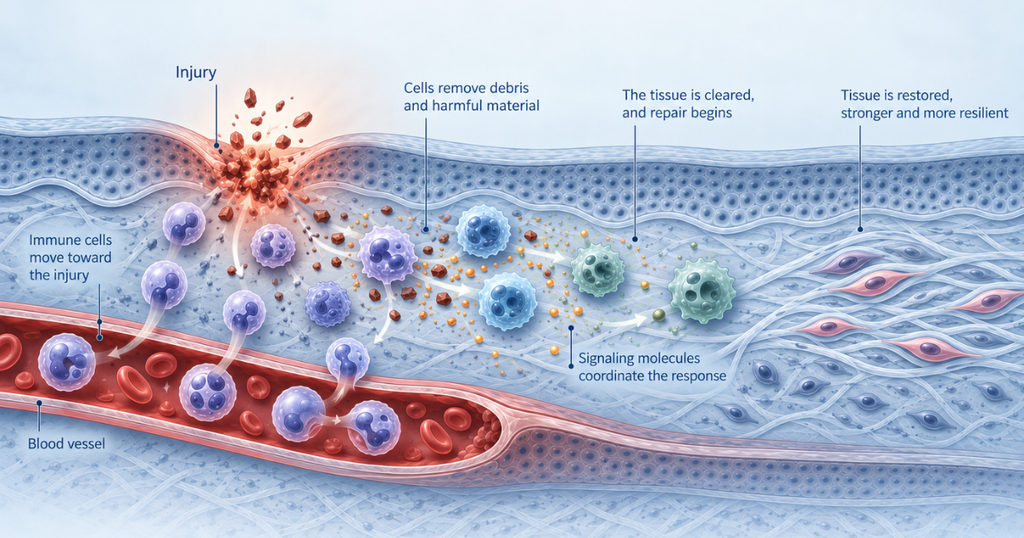
Once those signals are recognized, a series of changes begins. Blood vessels respond. Chemical messengers are released. Immune cells are recruited. Fluid and proteins move into the affected tissue, and cells begin identifying pathogens, damaged material, and debris that need to be removed.
What looks from the outside like redness, swelling, warmth, and discomfort is actually the visible part of a much more complex biological response happening underneath.
Inflammation isn’t one substance or one immune cell. It’s a coordinated process, and that process has a purpose.
Why Does Your Body Create Inflammation?
Imagine cutting your finger. The injury damages cells and blood vessels and breaks a barrier that normally keeps microorganisms outside your body.
Your body suddenly has several problems to solve. It needs to limit further damage, recognize and respond to anything that entered through the wound, remove damaged cells and tissue, and eventually, rebuild.
Inflammation helps create the conditions for those things to happen. Signals released around the injury change local blood flow and the behavior of nearby blood vessels. Immune cells are recruited into the area, and fluid, proteins, and other components of the immune response move where they’re needed.
Your body isn’t creating inflammation simply to make your finger red, swollen, and sore. Those symptoms are consequences of a much larger biological job underway. Your body is responding to damage so it can begin restoring what was disrupted.
Why Inflammation Looks and Feels the Way It Does
The classic signs of inflammation include redness, warmth, swelling, pain, and sometimes reduced function. They make more sense once we understand what’s happening underneath them.
Redness and warmth can develop as blood flow changes around the affected tissue. Swelling can occur as blood vessels become more permeable, allowing fluid, proteins, and immune components to move into the area.
Pain and tenderness can increase as inflammatory signals affect nearby nerve endings and make injured tissue more sensitive. And sometimes movement or function changes simply because the affected area is swollen, painful, or damaged.
These responses can be uncomfortable, but discomfort doesn’t necessarily mean the response itself is harmful. In the right context and for the right amount of time, many of the changes we associate with inflammation are part of the body’s attempt to protect an area and begin repairing it.
The Immune Cells That Do the Work
Inflammation also brings specialized cells into affected tissue.
Among the first responders are immune cells called neutrophils. Think of them like an emergency crew: fast to arrive, aggressive against invaders, and built for the first phase of a crisis—not for sticking around. Neutrophils attack invading microorganisms and begin clearing damaged material. They’re extremely useful during the early response, but they’re not meant to remain indefinitely.
Other immune cells, including macrophages, also play important roles. Macrophages are particularly interesting because what they do can change as healing progresses. Early on, they participate in defense and cleanup, engulfing microorganisms, damaged cells, and cellular debris.
But they also do something equally important: they help coordinate the transition from inflammation toward resolution and repair.
That transition matters because starting inflammation is only one part of successful healing. The body also needs to know how to finish the job.
Healing Requires More Than Starting Inflammation
This is where our usual understanding of inflammation can become too simple. We tend to think there are two possibilities: inflammation is present, or inflammation is gone.
But healing is much more dynamic than an on/off switch. A successful inflammatory response changes over time.
At first, the priorities may be to recognize, respond, defend, and clear. But eventually, the job needs to change. The body needs to limit further inflammatory-cell recruitment, clear cells that are no longer needed, change the chemical signals within the tissue, and create an environment that allows rebuilding to continue.
In other words, healing doesn’t simply require the body to create inflammation. It also requires the body to resolve it.
Your Body Actively Resolves Inflammation
For many years, the resolution of inflammation was often described as though the response simply faded away once the original problem disappeared. We now know the biology is more active than that.
Your body has coordinated mechanisms involved in bringing an inflammatory response toward an appropriate conclusion. One example happens after neutrophils have completed their work. Those cells eventually need to be removed, and macrophages engulf and clear these spent cells through a process called efferocytosis.
But this isn’t simply biological garbage collection. As macrophages clear cells and debris, the signals within the tissue begin to change. The environment can shift away from continued defense and toward resolution and tissue repair.
The body also produces signaling molecules involved in coordinating this transition. Some are known as specialized pro-resolving mediators, including families called resolvins, protectins, maresins, and lipoxins. You don’t need to remember those names. What matters is what they reveal: your body doesn’t simply wait for inflammation to stop. It has biological processes dedicated to helping bring that response to an appropriate end.
Resolution Isn’t the Same as Suppression
This distinction matters. If inflammation is part of healing, it might sound as though we should always let it continue unchecked. That’s not the case. There are many situations where reducing or controlling inflammation is medically appropriate and important.
But biologically, resolving inflammation and simply suppressing inflammatory activity aren’t exactly the same thing. Resolution is an active transition. The work of defense begins winding down. Cells that are no longer needed are cleared. Signals within the tissue change, and the environment becomes increasingly oriented toward repair and restoration.
The goal of a healthy inflammatory response isn’t to never create inflammation, and it isn’t to remain inflamed indefinitely. It’s to create an appropriate response for the situation, accomplish the necessary work, and then transition toward resolution and repair.
We can think of the larger process this way:
Recognize → Respond → Clear → Resolve → Repair
Each step has a job, and healing depends on the body’s ability to keep moving through the process.
When Inflammation Begins to Interfere With Healing
If inflammation helps initiate healing, why is persistent inflammation associated with so many health problems?
Because an inflammatory response that continues isn’t the same biological situation as one that successfully progresses toward resolution. Sometimes the original trigger is still present: an infection may persist, a tissue may continue to be injured or irritated, or an immune response may remain active. In other situations, the processes involved in resolving inflammation may not proceed normally.
When inflammatory activity persists, processes that were useful during the initial response can begin contributing to damage. Inflammatory cells and chemical signals designed to defend and clear tissue can interfere with restoration when they remain active for too long or in the wrong context.
This is especially easy to see in chronic wounds. A wound needs an inflammatory response early in healing, but a wound that remains in a persistently inflammatory environment can have difficulty progressing into effective tissue repair. The response that initially helped protect the tissue can eventually become one of the factors interfering with its restoration.
Inflammation isn’t necessarily the enemy. But it also isn’t meant to be the final destination.
Why Can Inflammation Persist?
There isn’t one answer, and this is another place where the conversation around inflammation can become overly simplistic. We sometimes talk about inflammation as though it is itself the underlying problem. But inflammation is a response, which means another useful question is: What is the body responding to?
Sometimes the answer is obvious, such as an acute infection or injury. Other times, ongoing inflammatory activity can occur alongside persistent infection, repeated tissue damage or irritation, autoimmune activity, metabolic dysfunction, or other physiological disturbances. Inflammatory responses can also differ depending on the tissue, the trigger, and the larger biological context.
So saying someone “has inflammation” doesn’t necessarily tell us why it’s happening. We still need to understand the context: What initiated the response? Is that signal still present? Is the tissue continuing to experience damage? Is the inflammatory response appropriate for what’s happening? And is the body successfully moving toward resolution?
Those are very different questions from simply asking how to get rid of inflammation.
What About CRP and Other Inflammation Markers?
You may have heard of blood tests that measure markers associated with inflammation, particularly C-reactive protein, or CRP. CRP levels can rise when inflammatory activity is occurring in the body, which can make it a useful clinical marker.
But a marker isn’t necessarily an explanation. An elevated CRP doesn’t automatically tell us exactly where inflammation is occurring, what caused it, or what needs to be done about it. It provides one piece of information that has to be interpreted in context.
This distinction matters because inflammation isn’t a diagnosis by itself. It’s part of the body’s response to something else.
Supporting the Conditions for Resolution and Repair
Once we understand inflammation this way, the goal of supporting healing begins to look different. It isn’t simply “fight inflammation.”
The body needs the ability to create an inflammatory response when that response is appropriate. It also needs the conditions that allow that response to accomplish its job and progress toward resolution and repair. Much like a construction crew, the body needs the right materials, timing, and coordination to move from cleanup to rebuilding.
Nutrition helps provide energy and raw materials for immune activity and tissue rebuilding. Circulation helps deliver oxygen, nutrients, immune cells, and signaling molecules where they’re needed. Sleep influences immune regulation and many of the processes involved in recovery. Movement affects circulation, tissue loading, and adaptation. The hormonal and nervous systems also communicate with the immune system and influence the larger environment in which healing takes place.
And if an infection, injury, irritation, or another trigger continues signaling that something is wrong, the body may continue receiving reasons to maintain an inflammatory response.
These are larger pieces of the healing process, and each deserves its own conversation. For now, the important point is this: inflammation doesn’t happen in isolation. It’s one part of the coordinated work your body is constantly doing to protect, repair, and restore itself.
Inflammation Isn’t One Thing
This is why it can be misleading to divide inflammation into simply “good” or “bad.” Inflammation from a cut on your finger isn’t identical to inflammation associated with an autoimmune condition. Inflammation during an infection isn’t identical to inflammatory activity associated with repeated tissue injury or metabolic disease. Even within the same inflammatory response, the cells and signals involved can change as time passes.
Context matters. Cause matters. Timing matters. Magnitude matters. And resolution matters.
The better question isn’t,”Is inflammation good or bad?” A more useful question is: What is this inflammatory response trying to accomplish, and is the body able to move through it appropriately?
Related Articles
- What Does Your Body Need to Heal?
- The Healing Response
- Building Blocks for Healing
- Sleep and Cellular Repair
Continue Your Discovery
If inflammation persists, the question isn’t always simply how to suppress it. Sometimes the more useful question is: why is the body continuing to create an inflammatory response?
There may be an ongoing trigger. There may be repeated tissue stress. Or there may be other factors influencing the environment in which recovery is trying to occur.
Understanding those patterns can provide important context for what the body may be responding to and what may be interfering with restoration.
Discovery Before Direction.
Learn About Total360 Discovery
FAQ
What is inflammation?
Inflammation is a coordinated biological response to injury, infection, damaged cells, irritants, or other signals the body recognizes as potentially harmful or disruptive. It involves changes in blood vessels, immune cells, chemical signaling, and surrounding tissue as the body works to protect the area and begin repair.
Is inflammation necessary for healing?
Inflammation is an important part of many normal healing responses. It helps recruit immune cells, clear damaged material, respond to potential infection, and prepare tissue for repair. Successful healing also requires the inflammatory response to eventually move toward resolution.
Why can inflammation become harmful?
Inflammation can become problematic when the response is excessive, inappropriate, repeatedly triggered, or doesn’t resolve normally. Persistent inflammatory activity can contribute to ongoing tissue damage and interfere with the transition toward effective repair.
What is the difference between inflammation and chronic inflammation?
Inflammation describes a broad biological response that can occur for many reasons. Chronic inflammation refers to inflammatory activity that persists over time. The cells, signals, causes, and biological processes involved can vary depending on the condition, tissue, and underlying trigger.